


Documentary Video Production for Brands and Causes


Documentary-style video is the simplest thing in the world to describe.
Real people. Real conversations. No script. We sit down with the people who actually live the story, ask honest questions, listen for the moments that matter, and build the finished film out of what gets said.
That’s the whole method. And it’s the hardest thing to actually do well.
This page is about why this method works, why it earns audiences instead of demanding them, and what kinds of brands and organizations it serves.
What Documentary-style Actually Means
The phrase gets used loosely. Most of the time, it means “the video has interviews in it” or “we shot it handheld for a more natural feel.” That’s not what we mean.
We mean a real methodology with real constraints.
We don’t write scripts for the people on camera. We write questions. The story comes out of the conversation, not the other way around. If we walk in knowing exactly what someone is going to say, we’re not interviewing them. We’re casting them.
We don’t use narrators. Voiceover is the easiest way to put words in someone’s mouth. Real people telling their own stories beats a polished voice telling theirs every time. Audiences feel the difference, even when they can’t name it.
We don’t use actors. The people in our films are the people in the actual story. Customers. Founders. Patients. Employees. The team behind the work. Real, named, on camera.
We do plan. Carefully. Pre-production is where we collaborate with the client to define what the film needs to accomplish, what the message is, who the audience is, and what truths we’re hoping the conversations will surface. Then we design the questions to draw those truths out of the subjects in their own words. The plan is rigorous. The conversation isn’t scripted. Those two things aren’t in conflict. They’re how the method actually works.
That’s the constraint. The reward is that audiences trust what they’re watching, because they should.
Why This Method Works
Audiences have spent two decades learning to spot the difference between someone telling them what to think and someone telling them the truth. The signals are subtle. The read is fast. A film with a script feels like a film with a script. A film built from real conversation feels like the thing actually happening, even when it’s been shaped by careful editing.
This is the part that matters for brands and causes.
A brand video that feels stage-managed will get watched politely. A brand video that feels honest will get shared, referenced, and remembered. Same audience, same length, same production value. The variable is whether the audience trusts what they’re seeing.
You can’t fake trust. You can only earn it. The way you earn it is by getting out of the way and letting real people speak.
A Small Mechanic Shop in Springfield, Illinois
We recently made a brand film for Floyd Imports, a car repair shop two brothers, Eric and David Floyd, opened in 1994 in a two-bay garage on Stevenson Drive in our hometown. No windows in the back. Hot in the summer, cold in the winter. A month of work in the books on opening day.
The Floyd brothers are still there thirty-one years later, and now the shop is passing to the next generation. Andy Floyd, Eric’s son, has been working there since he was sixteen. He’s running the place alongside another technician named Josh.
The film is about that handoff. The work, the relationships, the customers who started bringing in their own kids and grandkids. There’s also a small detail in the film that’s doing more work than it looks like it is, and how it got there is worth explaining.
Every Friday at six in the morning, before the shop opens, Eric meets with a small group of friends he’s collected over thirty years. An electrician. The banker. A friend his son grew up with. Eight guys, give or take. They drink coffee, talk about whatever, and then go on about their lives until next Friday.
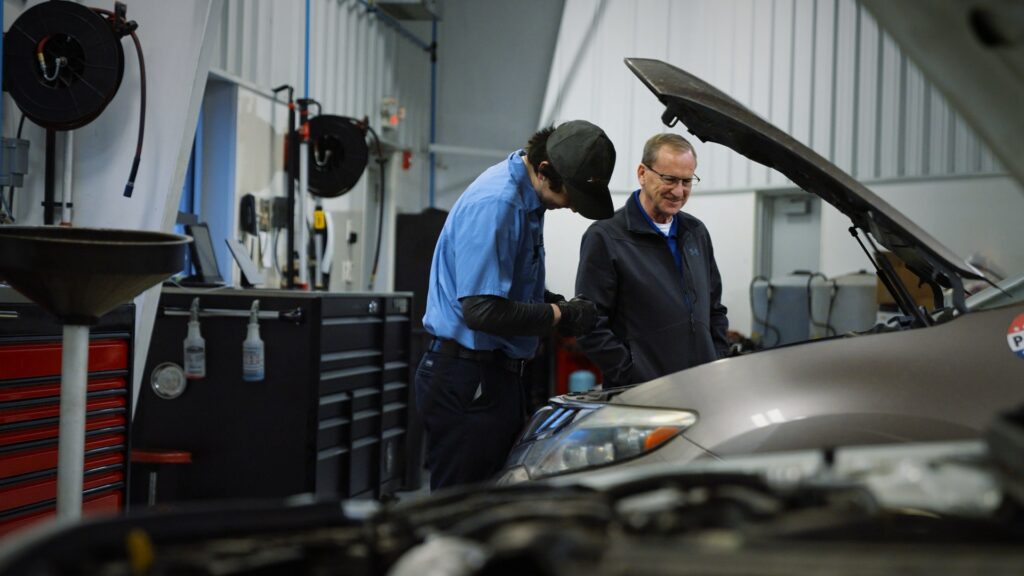
When we first met with Andy to talk about the project, the breakfast club was the story he wanted to tell. He thought the film should be about it. We had a different recommendation.
The breakfast club is interesting on its own. But in a brand film, what makes it powerful isn’t that it’s interesting. It’s that it’s evidence. The brothers say their business is about relationships, not transactions. Plenty of businesses say that. The breakfast club is proof. Thirty years of standing Friday mornings with the same circle of friends is the kind of thing a person who treats customers as transactions doesn’t have time to build.
So we kept the breakfast club, but we used it as evidence rather than thesis. The film makes the larger claim, these are guys who built a business by building relationships, and then the Friday morning ritual lands as the proof point that makes the claim believable.
This is a documentary technique we love. Specifics doing the work that generalities can’t. The viewer doesn’t have to take the brothers at their word, because they’ve seen the Tuesday morning version of the claim made true.
Andy described the breakfast club this way: “I always thought it was like a movie script. These eight guys get together. If they can make it, cool. If they can’t, cool. But a lot of times they all showed up. The Breakfast Club was the coolest thing I’d ever heard of.”
That line is what you can pull out of a person who’s been thinking about their family’s business for twenty years, if you set up the conversation right. That’s documentary work. Plan rigorously. Listen well. Use the specifics where they do the most work.
An Equestrian Architecture Firm in Washington, D.C.
The same method serves very different work.
We’ve been producing a brand film for Blackburn Architects, a Washington, D.C. firm that designs horse farms and equestrian facilities for clients around the world. John Blackburn, the founder, started the practice forty years ago after a chance call from a Boston landscape architect about a client who wanted to build a horse farm in Middleburg, Virginia. He took the job. He’s been doing the work ever since.
Blackburn’s projects range from five-acre farms to one that spans eighty-eight thousand acres. The firm designs houses, barns, breeding facilities, staff housing, arenas, and the entire layout of working horse properties. Their barns are passive machines, designed using the Bernoulli principle and the chimney effect to ventilate naturally even when there’s no wind. Every barn has a skylight, because every animal that lives in a building should have a window to the sky.
That’s the kind of thing John Blackburn says in an interview. It’s not on the firm’s website. We only got it by sitting down with him and asking the kind of questions that gave him room to describe his work in his own words.
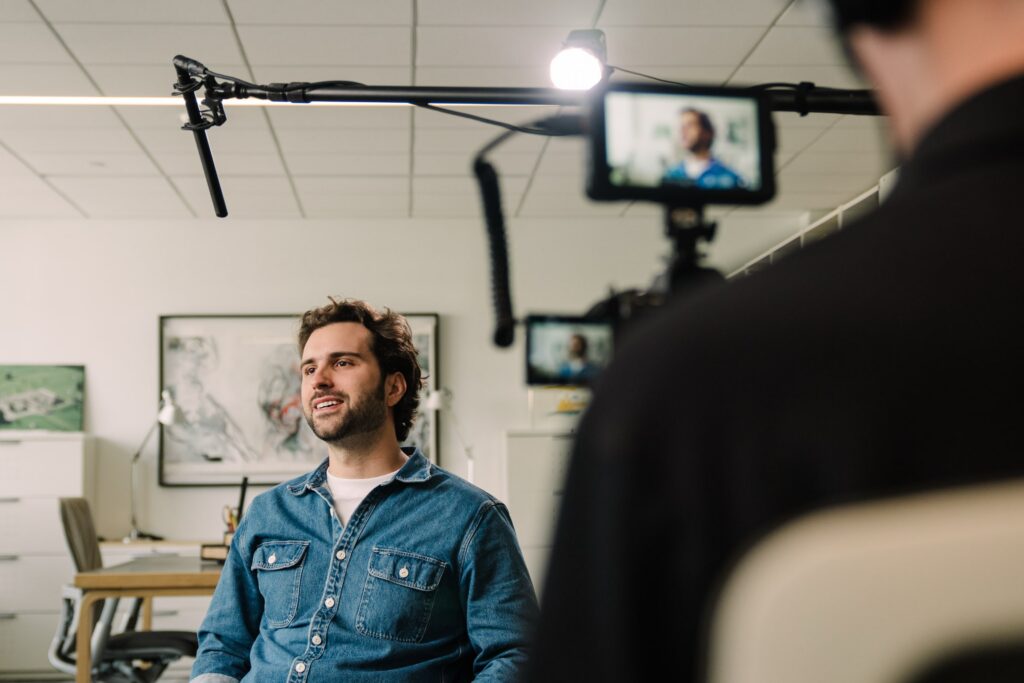
We’ve shot two days so far, one at the firm’s D.C. office and one across two farms in Virginia. Next week we travel to two more projects in California. Oregon comes after that. Each location is a new shoot day, a new set of interviews, a new layer of the same story. The film is being built out of what John, his team, and their clients actually say, the same way Floyd’s film was. Different business, different scale, different audience. Same method.
Both films will look different. The architecture film features grand spaces, working horses, expansive landscapes. The Floyd film features fluorescent shop lights, oil on concrete, two brothers in their early seventies sitting in their office. The underlying argument is the same in both. Real people telling the truth of their work, captured because someone planned the work carefully enough to leave room for it.
You can read the longer write-up of the project in our Blackburn Architects brand film case study.
What Makes This Hard To Do Well
The reason this method isn’t universal is that it’s deceptively difficult.
Designing the right questions for a particular client, audience, and message takes real strategic work. Conducting an interview that earns the truth from a stranger is a craft on top of that. So is taking four or five hours of footage from a single subject and finding the ninety seconds that serve the whole story best. Doing all of that well enough that the finished film feels effortless requires expertise at every step, even though the result is supposed to look easy.
Plenty of production companies can shoot a good frame. Plenty of brands and nonprofits try to do this work themselves to save the line item. The footage is usually fine. The story is usually missing.
That difference is the entire job. It’s also why thirteen years of doing this work matters more than the camera in the room. The craft is the difference between a video that gets watched politely and a video that does what video is supposed to do. Move people.
Who This Work is For
We work with brands and organizations that have decided they want something professional, cinematic, but also authentic, real, and trustworthy.
It’s good work for premium B2B brands building something difficult and specific. Architecture, manufacturing, professional services, consultancies, category-creating companies. The brands whose work is too sophisticated to explain in a thirty-second spot and too important to leave to a stock-footage marketing video.
It’s good work for legacy businesses going through a moment of change. Generational handoffs. Founder retirements. Acquisitions. Anniversaries that mean something. Stories that won’t keep forever and deserve to be captured while they can be.
It’s good work for mission-driven organizations preparing for moments where the story has to do real work. Annual galas, capital campaigns, donor cultivation, board recruitment. The moments where the audience needs to feel what you do, not just understand it.
Want To Tell Yours?
If you’re a brand or organization with a story worth telling well, we’d be glad to talk. We’ve done this work for thirteen years, across twenty-three states, and we still find ourselves on a shop floor or in a barn somewhere thinking, this is the part you can only get by being here.
That’s the whole pitch. Real people. Real conversations. Messaging that earns trust and builds long-term loyalty.
READ LATEST
the



we're storyteller studios
documentary-style film for brands & causes
In 2013, we started leveraging the power of documentary-style film for brands and causes in our hometown of Springfield, Illinois (hence our affinity for Lincoln).
Since then, we’ve worked with clients nationally and traveled to cities including Chicago, St. Louis, Kansas City, Indianapolis, Louisville, and Des Moines.
No matter where you are, we’d be honored to serve your brand next.
featured post
The 7 Types of Videos People Watch and Share the Most
Some video types reliably outperform others. Here's the framework we use to choose the right format for each project, and why story-driven choices outperform formula every time.
